
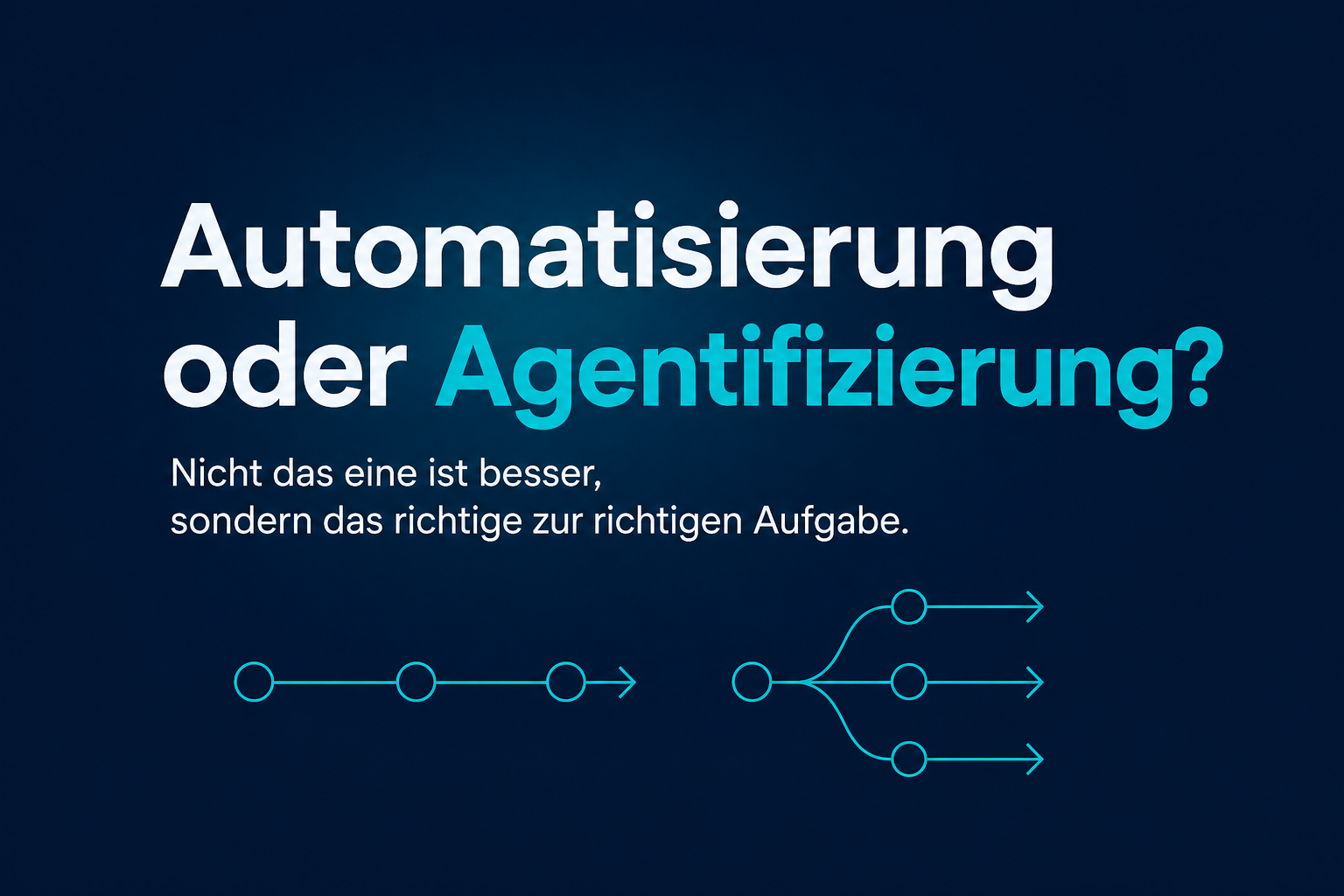
When someone says „we automate that with AI”, it can mean two very different things. An automated process that follows fixed rules. Or an agentic process that decides for itself and adapts as it goes. Both are AI. Both can make sense. But they work in fundamentally different ways, and anyone who does not know the difference will make the wrong choice.
What automation does (and why that is often enough)
An automated process follows a defined sequence. When A happens, do B. When B is done, do C. The logic is fixed in advance, the order is fixed in advance, the result is predictable. An example from everyday marketing: a new blog article is published, a social media post is automatically created from it, the editorial calendar is updated, and a notification is sent to the team. Every step is clear, every step happens in the same order, every step delivers an expected result.
That sounds simple, and that is exactly the point. Automation is simple. It takes repetitive work off your plate that you would otherwise have to do manually. It does not make careless mistakes, it does not forget a step, it does not need a coffee. For everything that repeats and where the result is clearly defined, automation is the better choice. Less complexity, less maintenance, fewer surprises.
What agentic processes do differently
An agentic process is not linear. Instead of a fixed chain of if-then steps, there is a goal, and the agent decides for itself which path to take. It can evaluate intermediate results, change its approach, gather additional information, or repeat a step if the result was not good enough.
Let us stay with the content example. Instead of „publish the post and send a notification”, an agentic process might look like this: the agent is given the task of writing a LinkedIn post on a specific topic. It first checks which posts have performed well recently. It looks at the language profile. It writes a first draft, evaluates it against the quality criteria, discards it, writes a second one. Then it decides whether an image would make sense, and if so, hands off a brief to a specialised image agent.
The decisive difference: the agent makes decisions during the process. It reacts to what it finds. The path to the result is not fixed in advance.
Variance is both feature and risk
And this is exactly where things get interesting in practice. Automation always delivers the same result for the same input. That is its strength. Agentic processes potentially deliver different results for the same input, because the agent makes decisions along the way that can turn out differently next time.
For some tasks, that variance is exactly what you want. When an agent drafts a blog post, you do not want the same text every time. You want it to find the best approach for this particular topic, even if that means it occasionally picks an unusual opening or tries a different structure.
For other tasks, variance is a problem. If you need a monthly report from the same data sources, in the same format, with the same KPIs, you do not want creative interpretation. You want reliability. You want row 4 to always show the conversion rate, whether it is Monday or Friday.
When each one fits
The choice between automation and an agentic process is not a question of better or worse. It is a question of the task.
Automation fits when the process is clearly defined, the steps do not change, the result should be predictable, and speed matters more than flexibility. Reporting, data transfer between systems, notifications, format conversion, editorial calendar updates. Anything where you say today „I do this the same way every week” is a candidate.
Agentic processes fit when the task requires context, decisions have to be made along the way, and the quality of the result depends on the ability to react to intermediate findings. Content creation, campaign analysis with recommendations, briefing creation, competitive monitoring with interpretation. Anything where a human says today „it depends” points to an agentic process.
Most teams need both
In practice, it is rarely an either-or. A well set-up marketing team uses automation for the infrastructure: data flows, systems are connected, routine tasks run without manual intervention. And it uses agentic processes where judgement is required: in creation, in analysis, in evaluation.
At AGENTICAL we frequently see teams that want to start with automation but actually have an agentic problem. Or the other way round: teams that want to deploy an AI agent for something that a simple automation would handle in a tenth of the time. The question „do I need an agent or an automation?” is one of the first we clarify in the potential check. The answer often saves weeks of false starts.
If you want to know where in your own marketing each approach has the biggest leverage, our AI readiness check at check.agentical.de gives an initial orientation. Free, in ten minutes, with no sales call.